
Bitcoin has a unique monetary system that controls how new coins enter circulation. Unlike traditional currencies, Bitcoin follows a predetermined issuance schedule built into its protocol. One of the most important parts of this schedule is halving, an event that reduces the reward miners receive for adding new blocks to the blockchain.
Understanding bitcoin halving dates 2012 2016 2020 2024 helps readers explore Bitcoin’s monetary policy, historical reward changes, and the reasons halvings attract attention from cryptocurrency users. Each completed event has reduced the rate at which new bitcoins are created, but none has guaranteed a particular market outcome.
This guide explains the four historical events, how mining rewards changed, why the dates matter, and what beginners should understand before drawing conclusions about Bitcoin’s future.
What Is Bitcoin Halving?
Bitcoin halving is a programmed event that cuts the block subsidy paid to miners by 50%. It occurs every 210,000 blocks, which generally takes around four years.
Bitcoin miners use specialized computers to compete to produce valid blocks. When a block is accepted by the network, the successful miner can claim the block subsidy and eligible transaction fees. The subsidy consists of newly created bitcoins, while transaction fees come from users’ transactions.
The original subsidy was 50 BTC per block. Following successive halvings, it decreased to 25 BTC, 12.5 BTC, 6.25 BTC, and then 3.125 BTC in 2024.
This predictable reduction is a core feature of Bitcoin’s monetary design. Its protocol limits the total supply to approximately 21 million BTC and gradually slows the creation of new coins.
Bitcoin Halving Dates 2012 2016 2020 2024: Historical Overview
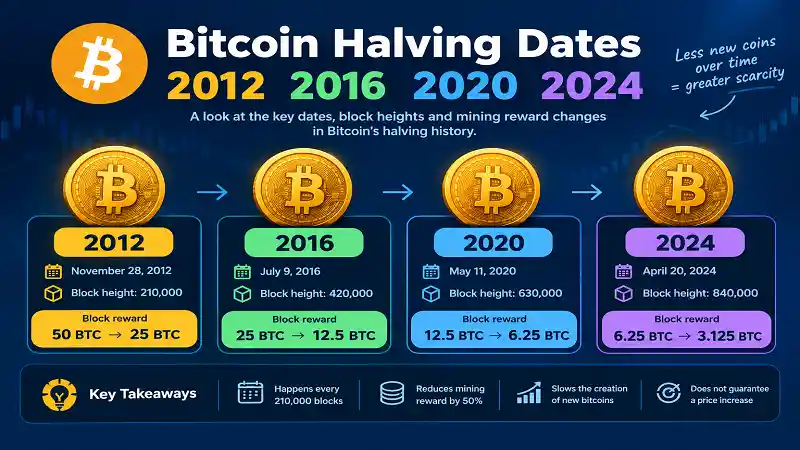
The four completed halvings occurred at specific blockchain heights. They were not triggered by calendar dates; the dates below identify when the relevant blocks were produced.
| Halving | Date | Block height | Subsidy before | Subsidy after |
|---|---|---|---|---|
| First | November 28, 2012 | 210,000 | 50 BTC | 25 BTC |
| Second | July 9, 2016 | 420,000 | 25 BTC | 12.5 BTC |
| Third | May 11, 2020 | 630,000 | 12.5 BTC | 6.25 BTC |
| Fourth | April 20, 2024 | 840,000 | 6.25 BTC | 3.125 BTC |
The fourth halving occurred on April 20 in Coordinated Universal Time. Some sources display April 19 because the event happened on the previous evening in certain time zones.
These historical dates show how Bitcoin’s issuance schedule has progressed through four successive reductions.
The First Bitcoin Halving in 2012
The first halving occurred on November 28, 2012, at block height 210,000. The subsidy fell from 50 BTC to 25 BTC per block.
Before this event, miners could claim 50 newly created bitcoins for each valid block. After the change, they could claim only half that amount, plus eligible transaction fees.
Why the 2012 Halving Was Important
The first halving demonstrated that Bitcoin’s monetary rules could reduce new issuance automatically without requiring a central authority to make a decision.
At that time, Bitcoin was still a relatively small market. Public awareness, mining infrastructure, and cryptocurrency trading were much less developed than they are today.
The 2012 event established the pattern that later halvings would follow. It also highlighted an important distinction: Bitcoin’s issuance schedule is programmed, but its market price is determined by changing market conditions.
The Second Bitcoin Halving in 2016
The second halving took place on July 9, 2016, at block height 420,000. The block subsidy decreased from 25 BTC to 12.5 BTC.
By 2016, Bitcoin had attracted more attention from users, traders, developers, and mining businesses. The ecosystem had grown, and mining increasingly required careful decisions about hardware performance and electricity costs.
Effects on Miners and Bitcoin Supply
The reduced subsidy meant miners received fewer newly created bitcoins per block. If the market price and transaction-fee income did not compensate for the reduction, some mining operations could experience lower profitability.
The event also drew attention to Bitcoin’s limited supply. However, market movements around the 2016 halving were influenced by several factors, and the event alone cannot explain every price change.
The Third Bitcoin Halving in 2020
The third halving occurred on May 11, 2020, at block height 630,000. The block subsidy decreased from 12.5 BTC to 6.25 BTC.
The event took place during the COVID-19 pandemic, when global financial markets were experiencing unusual uncertainty. Economic policy changes, liquidity conditions, and investor sentiment were affecting markets across the world.
What Made the 2020 Halving Significant?
Bitcoin had become more widely recognized than it was during the previous halving. The reduction in new issuance attracted attention from cryptocurrency users and financial-market observers.
Nevertheless, Bitcoin’s market price depended on many factors, including demand, economic developments, trading activity, and investor expectations. The subsidy reduction was predictable, but the market response was not.
This event illustrated why technical changes and market outcomes should be considered separately.
The Fourth Bitcoin Halving in 2024
The fourth halving took place on April 20, 2024, at block height 840,000. The subsidy fell from 6.25 BTC to 3.125 BTC per block.
This was the fourth scheduled reduction in Bitcoin’s block subsidy. The change reduced the number of newly created bitcoins miners could claim, while transaction fees continued to be calculated separately.
What Changed After the 2024 Halving?
Mining businesses had to consider the lower subsidy alongside electricity prices, equipment efficiency, maintenance costs, and transaction-fee revenue. Less efficient operations can face greater financial pressure when rewards decline.
The 2024 halving took place in a more developed cryptocurrency environment than the earlier events. Bitcoin had broader visibility among individual and institutional market participants.
Even so, the event did not guarantee a price increase. Demand, existing holders’ decisions, liquidity, regulation, and broader economic conditions continued to influence the market.
How Bitcoin Halving Changes Mining Rewards
The history of bitcoin halving dates 2012 2016 2020 2024 demonstrates a consistent pattern: the block subsidy is cut in half every 210,000 blocks.
The reward reduction directly affects miners’ potential income from newly created bitcoins. Mining profitability also depends on transaction fees, electricity costs, hardware efficiency, network difficulty, and the market price of BTC.
Assuming the network produces approximately 144 blocks per day, the subsidy would create roughly these amounts of new bitcoin per day at different stages:
- At 50 BTC per block: approximately 7,200 BTC per day.
- At 25 BTC per block: approximately 3,600 BTC per day.
- At 12.5 BTC per block: approximately 1,800 BTC per day.
- At 6.25 BTC per block: approximately 900 BTC per day.
- At 3.125 BTC per block: approximately 450 BTC per day.
These figures are estimates based on an average ten-minute block interval. Actual daily issuance varies because blocks are not produced at perfectly regular intervals.
Do Bitcoin Halvings Increase the Price?
Many people expect halving to affect Bitcoin’s price because it reduces the rate of new supply. If demand remains strong while fewer new coins enter circulation, supply dynamics may influence market conditions.
However, a halving does not guarantee that the price will increase. Several factors can affect Bitcoin’s market value.
Supply and Demand
Prices reflect buyers’ and sellers’ decisions. A lower rate of new issuance does not prevent existing holders from selling their bitcoins.
Market Expectations
Investors may anticipate a halving well before it occurs. As a result, expectations about the event may already influence prices before the subsidy changes.
Economic Conditions
Interest rates, inflation expectations, market liquidity, and wider financial conditions can affect demand for cryptocurrency.
Regulation and Investor Sentiment
Government policies, legal developments, and changes in confidence can influence participation in cryptocurrency markets.
Historical price performance is useful for understanding past behavior, but it cannot reliably predict future returns.
When Is the Next Bitcoin Halving?
The next halving is expected around 2028, at block height 1,050,000. The subsidy is scheduled to decrease from 3.125 BTC to 1.5625 BTC per block.
The exact date cannot be guaranteed years in advance because Bitcoin triggers halvings at specific block heights rather than on fixed calendar dates. Block production times vary around the network’s ten-minute target.
Future halvings will continue reducing the block subsidy. Over time, new issuance will approach zero as Bitcoin follows its supply schedule toward the designed limit of approximately 21 million coins.
Frequently Asked Questions
1. What are the Bitcoin halving dates for 2012, 2016, 2020, and 2024?
The four dates are November 28, 2012; July 9, 2016; May 11, 2020; and April 20, 2024.
2. How many Bitcoin halvings have occurred?
Four halvings have been completed since Bitcoin launched in 2009.
3. What was the block subsidy after the 2012 halving?
The subsidy decreased from 50 BTC to 25 BTC per block.
4. What was the reward after the 2020 halving?
The block subsidy decreased from 12.5 BTC to 6.25 BTC per block.
5. What is the block subsidy after the 2024 halving?
The subsidy is 3.125 BTC per block. Miners may also receive transaction fees, which are separate from the subsidy.
6. Does Bitcoin halving happen exactly every four years?
No. It happens every 210,000 blocks. The interval is approximately four years because Bitcoin targets an average block time of ten minutes.
7. Does halving guarantee a higher Bitcoin price?
No. Prices depend on supply and demand, investor expectations, liquidity, regulations, and broader economic conditions.
Conclusion
Bitcoin’s halving schedule is an important part of its monetary design. The events in 2012, 2016, 2020, and 2024 reduced the block subsidy from 50 BTC to 3.125 BTC, slowing the rate at which new bitcoins enter circulation.
Understanding bitcoin halving dates 2012 2016 2020 2024 helps readers compare historical rewards and understand why each event matters to Bitcoin’s supply schedule. However, halvings do not guarantee higher prices or investment profits. A balanced understanding combines the technical facts with an awareness of market uncertainty.